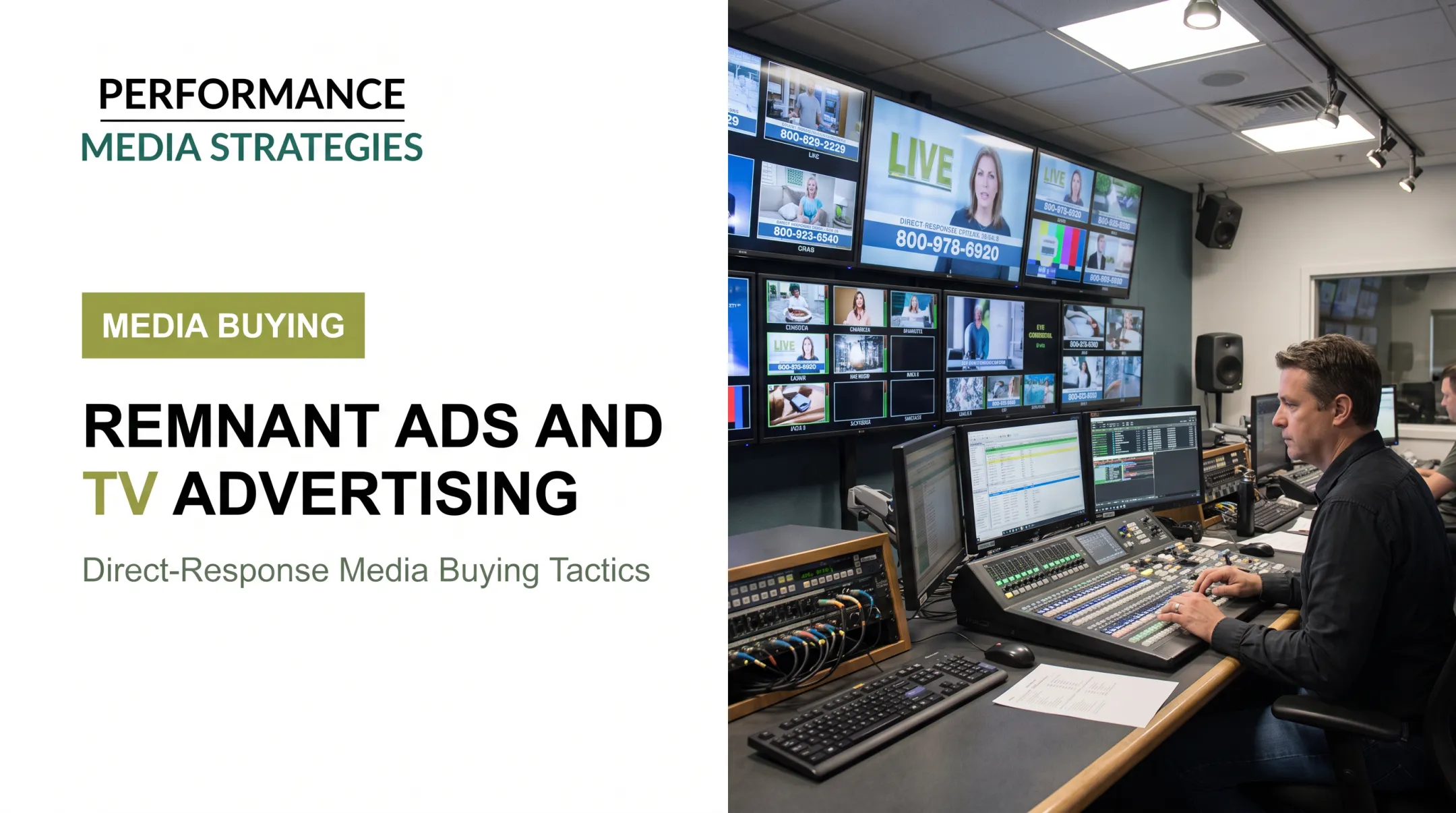
First-time buyers run into the same questions again and again: What does airtime actually cost? Should I go with broadcast or streaming? How do I keep the creative compliant? And once the spot airs, how do I prove it generated calls, leads, or sales rather than just impressions?
This guide walks through the buying process step by step: how pricing works, what a direct-response campaign needs before launch, and how a performance-based media partner can help manage the financial risk that comes with testing a new channel.
Key Takeaways
- Budget separately for creative production and airtime or media distribution.
- Cost swings with audience, market, daypart, spot length, season, and inventory demand.
- Pair every airing with a trackable number, URL, or landing page.
- Judge media value by campaign objectives, not the lowest spot price.
- Performance Media Strategies manages performance-based TV and Pay Per Call campaigns for advertisers seeking to limit upfront risk.
Why Businesses Buy TV Commercial Advertising
Television remains one of the few channels that combines sight, sound, motion, and storytelling with broad household reach. That combination makes it useful for two very different jobs: building brand awareness and generating a direct response.
Brand-building campaigns prioritize reach, frequency, and recall so a message reaches as many relevant households as possible. Direct-response campaigns prioritize action: calls, qualified leads, appointments, or sales tied to a specific offer.
Industries that often lean toward response-focused TV include:
- Health insurance, including ACA and under-65 plans
- Final expense and senior life insurance
- Home improvement, such as bath remodeling and roofing
- Long-distance moving and relocation services
- Consumer legal and claims intake
TV isn't the right fit for every advertiser. It tends to underperform when:
- There's no clear, specific offer to react to
- Inbound calls or web inquiries can't be answered promptly
- The business can't fulfill demand across the geography the spot reaches
- There's no way to measure what the campaign produced
Those limits matter, but the audience opportunity is still large. Ad-supported viewing made up 72.4% of total U.S. TV time in Q1 2025, according to Nielsen's 2025 report. Most viewing still happens where ads can run. That doesn't guarantee results for any single campaign, yet it explains why TV remains viable for reaching large audiences at scale.
Performance Media Strategies operates a multi-channel Pay Per Call network spanning radio, TV, print, internet, mobile, and call-center affiliates. It connects interested consumers in these response-driven categories directly to an advertiser's call center.
How to Buy a TV Commercial: A Step-by-Step Process
Build Your Media Brief
Before contacting a station, network, streaming platform, or agency, define the basics of your campaign:
- Objective, such as brand awareness, lead volume, calls, or appointments
- Target customer and serviceable geography
- Offer and call to action
- Desired response volume
- Primary success metric
These answers become your media brief, the document you'll hand to any seller or partner. A complete brief also covers:
- Audience characteristics and customer value
- Available budget and campaign dates
- Creative assets and compliance requirements
- Call-center capacity and geographic restrictions
Compare Your Buying Routes
Three paths cover most advertisers:
- Direct negotiation with a local broadcast station, station group, cable operator, or network representative
- A media agency or performance partner that plans inventory, negotiates placement, coordinates creative, and manages optimization
- A streaming or CTV platform, where audience targeting, setup, and reporting function more like digital advertising
Each route should produce a media plan. Ask for one that spells out:
- Inventory type, markets, and dayparts
- Programs or channels
- Expected reach and frequency
- Placement fees, make-good terms, and cancellation terms
- Reporting schedule
Cable providers often require two or more weeks' advance notice to cancel a running schedule. Confirm this before signing anything.
Prepare Operations Before Launch
Before the first spot airs, lock in the operational basics:
- Technical specs and clearance or content review
- Airing deadlines
- A working phone number and functioning landing page
- Adequate customer-service staffing
A polished spot that hits air without a ready response system wastes the airtime, not just the production budget.
Launch With a Test-and-Optimize Plan
Once the campaign starts, resist the urge to immediately shuffle budget or creative:
- Establish a baseline for calls, leads, web activity, appointments, or sales before the first spot airs
- Monitor response by placement, time period, creative version, market, and offer
- Shift budget or revise creative only after enough response data has accumulated to be meaningful

Performance Media Strategies develops, implements, manages, and optimizes performance-based campaigns across TV and other offline and online channels, keeping advertiser, agency, and vendor incentives aligned throughout.
How Much Does It Cost to Buy a Commercial on TV?
Total TV advertising cost breaks into two separate budgets: creative production and media placement. Treat them separately when planning, because they scale independently. A $5,000 spot can air alongside a $50,000 one.
What Drives Airtime Cost
Media pricing moves on several variables:
- Market size and geographic coverage
- Broadcast, cable, streaming, or CTV inventory type
- Program popularity, audience composition, and estimated reach
- Daypart, day of week, seasonality, and competing-advertiser demand
- Spot length, frequency, guaranteed placement, and package commitments
Published rate cards illustrate how wide that range gets:
| Placement | Market | Spot Length | Published Price |
|---|---|---|---|
| WABC, Good Morning America | New York, NY | 30 sec | $8,000 |
| WVII Morning News | Bangor, ME | 30 sec | $125–$250 |
| CNBC (national interconnect) | Up to 50M households | 30 sec ROS | $645–$850 |
| CNN (national interconnect) | Up to 50M households | 30 sec ROS | $2,363–$3,928 |

These are snapshots from rate cards updated in early 2025, not current nationwide averages. Always request a fresh quote for your market and dates.
Streaming entry points can be far lower. Disney's self-service platform sets a campaign floor around $500. Amazon's streaming TV ads carry no stated minimum for basic access, though the company recommends roughly $10,000 for self-service campaigns.
What Drives Production Cost
Production budgets shift based on:
- Script development and legal review
- Location, cast, and voice talent
- Animation, filming, and editing
- Graphics and music licensing
- Number of cut-downs needed for different lengths or markets
Building an Illustrative Budget
A realistic TV budget framework typically includes:
- Creative production
- Airtime or media spend
- Agency or platform fees
- Tracking and call-handling costs
- Testing and contingency reserve
To control cost, consider:
- Shorter spots and off-peak placements
- Remnant inventory and negotiated packages
- Repurposed creative and phased testing
Don't compare quotes on airtime price alone. A cheap spot in front of the wrong audience, with no response tracking or poor call handling, costs more in missed business than a pricier, better-targeted placement.
Choose the Right TV Advertising Format and Placement
| Format | Geographic Control | Targeting | Typical Commitment |
|---|---|---|---|
| Broadcast TV | Station or market-based | Program and daypart | Upfront or scatter buys |
| Local cable | Zone or geography-based | Program and geography | Negotiated by budget |
| National cable | Multi-market or national | Program and daypart | Package or interconnect deals |
| Streaming/CTV | Household-level | ZIP code, age, gender, interest | Often self-service, lower floors |
Linear buying works through stations, programs, and dayparts. Streaming buying adds household, geographic, behavioral, contextual, or first-party audience targeting, which is closer to digital media buying than traditional TV.
Choose local, regional, or national distribution based on your serviceable geography, customer density, and fulfillment capacity, not perceived prestige. A home-improvement contractor covering three counties gains little from national reach.
Spot length matters too. Shorter spots (15 seconds) cost less in production and media but leave little room for a complex offer. Longer spots (30 or 60 seconds) allow more explanation but demand more budget on both sides.
For direct response, placement quality often matters more than reach alone. Weigh proximity to relevant programming, audience intent, consistent scheduling, and whether viewers have a practical way to respond right away.
Prepare the Commercial and Response System Before Going Live
A response-oriented commercial needs more than a catchy script. Build it around:
- A specific audience problem the viewer recognizes immediately
- A credible benefit, not a vague promise
- A clear, singular offer
- Proof or a trust signal, such as a testimonial or guarantee
- A memorable brand cue
- A direct call to action with contact information repeated at least twice
The phone number, URL, promo code, or QR code on screen must be easy to remember, technically functional, and wired into your tracking system before the first airing.
Get Operations Ready Before Air
- Train the call center or sales team to recognize TV-sourced callers and handle expected volume
- Define lead qualification, call routing, hours of operation, and overflow procedures
- Confirm landing pages, forms, CRM records, and attribution tags are capturing responses correctly
Don't Skip Compliance Review
Insurance, health, financial, home-services, and legal advertising all carry specific regulatory requirements, including Medicare marketing disclaimers, health-claim substantiation, state insurance rules, and lending disclosures. Have a compliance professional review creative before it airs, not after.
The cost of skipping this step is real. In 2024, CarShield and an affiliated company agreed to pay $10 million to resolve FTC charges tied to deceptive advertising. The case cited a single commercial that aired roughly 18,000 times, according to the FTC's 2024 settlement.

Creative that clears review still needs disciplined testing. Test multiple messages, offers, or lengths when budget allows, but change one variable at a time. A polished commercial won't compensate for a weak offer, slow call handling, or a broken landing page.
Measure TV Advertising by Business Outcomes
Measuring a TV campaign means moving beyond "it aired" toward "what did it produce." Build a hierarchy:
- Exposure and delivery, including spots aired, estimated audience, and frequency
- Engagement and response, such as calls, web visits, and form starts
- Business outcomes, including qualified leads, appointments, sales, revenue, and cost per outcome
Attribution Methods That Work for TV
- Dedicated or call-tracking phone numbers by campaign, market, station, or creative version
- Unique URLs, promo codes, and QR codes tied to specific airings
- Time-based response analysis around when spots actually aired
- CRM matching that feeds lead status back into campaign reporting
- Matched-market, holdout, or marketing-mix modeling for larger budgets
A spike in calls right after a spot airs is useful evidence, but it's not automatic proof TV caused every response. Matched-market testing, comparing exposed markets to similar unexposed ones, gives a cleaner read.
One multiscreen study of five regional home-improvement and furnishings brands, run by Comcast and Mastercard, found a 3X incremental return on ad spend and a 7.3% sales lift when comparing exposed ZIP codes to matched control areas, according to Comcast's multiscreen study. That result reflects those five brands and categories, not a guarantee for every vertical.

Ask your media partner for regular reports covering spend, delivery, estimated audience, frequency, calls, qualified calls, lead acceptance, appointments, sales, revenue, and cost per outcome wherever available. Optimize carefully. Identify underperforming placements, sharpen creative or offer clarity, and adjust schedule and frequency. Reallocate budget only after accounting for data quality and your typical sales-cycle length.
Performance Media Strategies builds its performance-based model and multi-channel Pay Per Call network around this same discipline, connecting interested prospects directly to an advertiser's call center and tying campaign management to agreed outcomes, without promising a specific result in advance.
Frequently Asked Questions
How do I buy a TV commercial?
Define your audience, objective, and offer first, then produce compliant creative and compare media plans from stations, networks, or streaming platforms. Purchase placement, connect a trackable response path, and monitor results after launch to optimize.
How much does it cost to buy a commercial on TV?
Cost varies by production scope, market, format, audience, program, daypart, spot length, season, and fees. There's no single number, so request a current, itemized quote for your specific market and dates.
What is the difference between the cost to produce a TV commercial and the cost to air it?
Production is typically a one-time or periodic expense for creating the video. Airtime is a recurring media-distribution cost that varies by placement, so budget separately for both, plus tracking and response handling.
Is broadcast TV or streaming TV better for a direct-response campaign?
Neither is universally better. The right choice depends on your audience, geography, budget, targeting needs, and measurement requirements, and many advertisers test both to see which delivers stronger qualified response.
How can I track calls and leads from a TV commercial?
Use dedicated call-tracking numbers, unique URLs, promo codes, and QR codes tied to specific airings. Match that data against your CRM and review response timing to validate which placements generated qualified activity.
How can a business reduce the financial risk of buying TV advertising?
Start with phased testing, clear success criteria, and negotiated inventory terms. Working with a performance-based media partner can also help align costs with the results your campaign actually delivers.